What stands out in Sonic Visualiser
A waveform makes it possible to inspect an event that disappears almost as soon as you hear it. Sonic Visualiser lets you listen, zoom and annotate the same stretch of a recording. The useful skill is choosing a consistent landmark. A drum sound may reach its loudest point well after the stick lands. Comparing the tallest peak on one hit with the first edge on the next can manufacture timing errors.
Walkthrough
- Open the four-tap practice WAV or make your own short recording. Listen once without watching the screen. Tap along and note where the rhythm feels as though it hesitates. Start with a prediction so the most eye-catching peak on screen does not automatically become your answer.
- Zoom horizontally until all four attacks are easy to distinguish. Use the beginning of each burst of energy as the landmark. If using your own recording, ignore an isolated click before the drum unless you can hear that click as the start of the hit. Apply that rule consistently.
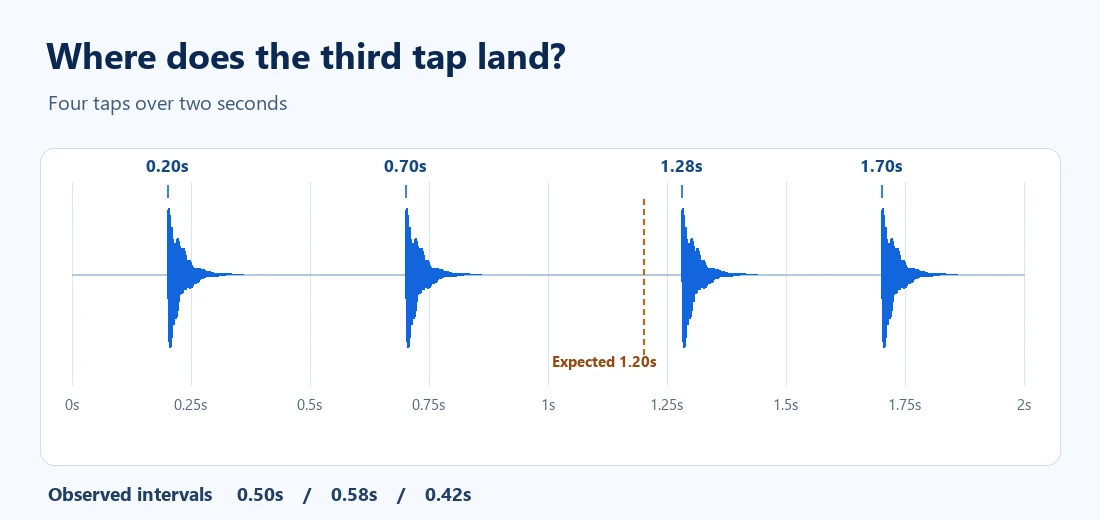
- Add a time-instants layer and mark the four onsets. Read their positions and subtract each previous time from the following one. You should end up with three gaps. A single late interior note produces a longer gap before it and a shorter one afterward if the next note returns to the original pulse.
- Select and loop the phrase. Listen first to the long gap, then to the short one. Widen the selection if the loop itself creates an artificial extra beat at the boundary. Save the session alongside a stable copy of the original audio so you can return to the same annotations.
Field tip
Leave the ruler at a readable scale while placing your first marks. Zoom farther in for the second pass only. If two readings differ by a few milliseconds, check whether you changed from measuring an onset to measuring a peak.
Where it falls short
A waveform exposes timing differences. It does not decide whether a drummer intended to lean behind the beat. Place markers before drawing a musical conclusion.
Try it yourself
In the practice file the onsets fall at approximately 0.20, 0.70, 1.28 and 1.70 seconds. The gaps are 0.50, 0.58 and 0.42 seconds. The fourth tap is back on the original pulse. Moving only the third tap earlier by 0.08 seconds would make the spacing even.
Download practice file · WAV ↓